The idea to take with you
Help customers complete a useful task, and judge the result on profit as well as sales.
Customers often arrive with a task rather than a product in mind: a quick dinner, a birthday present, a comfortable reading corner. Merchandising makes the connection between the task and the things that complete it. The opportunity is to reduce the work of choosing while preserving value for both the shopper and the store.
1. Choose a real shopping occasion
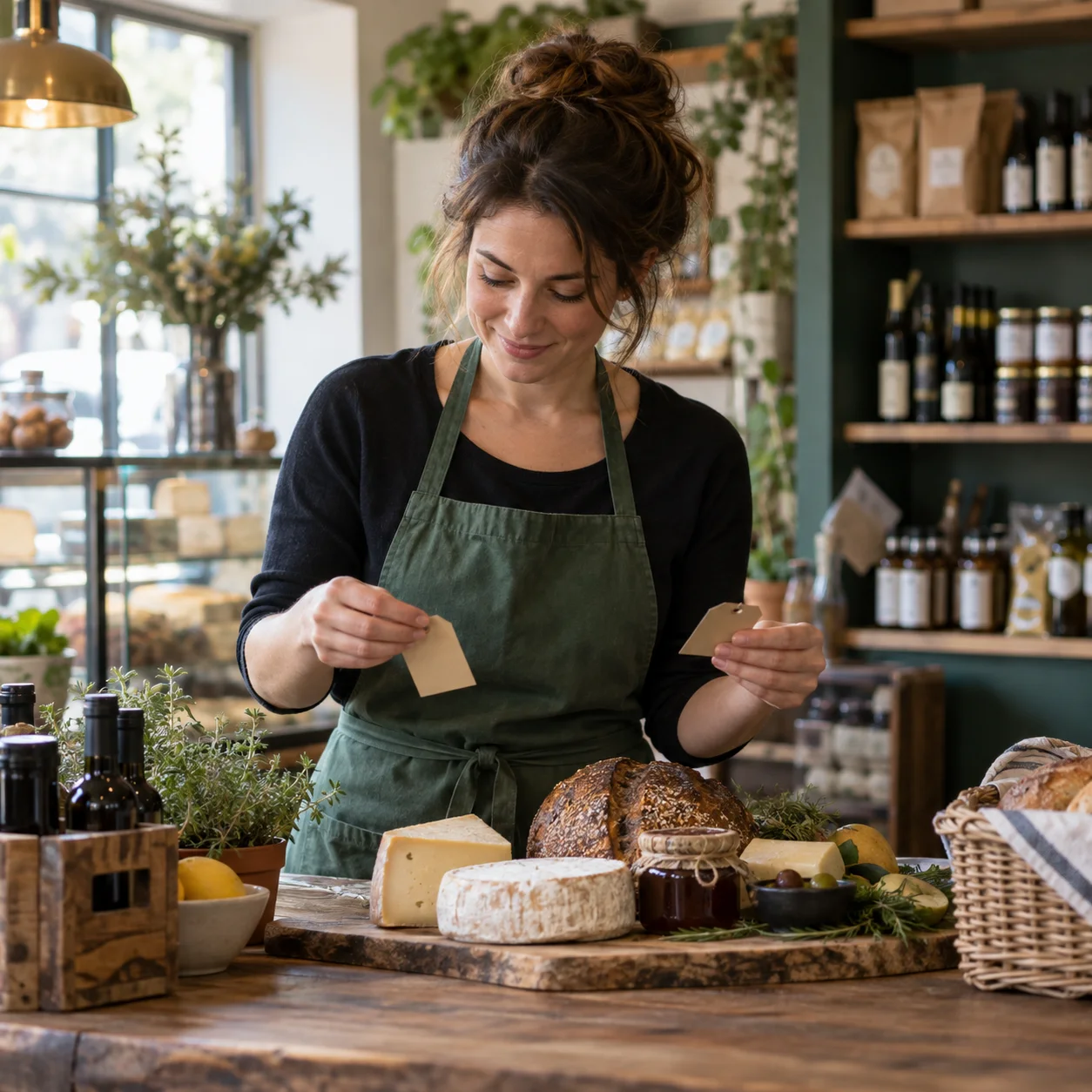
Spend a week noting which products are bought together and what shoppers ask before choosing. Pick an occasion that your team understands and your stock can support. A bread, cheese, and preserve selection has a clear use; an unrelated collection of slow sellers needs a stronger reason to exist.
Build a small display around the occasion. Give it a straightforward title, show individual prices and any bundle price clearly, and leave enough space for customers to handle the products. Ask staff to explain who the selection is useful for in one sentence. If that is difficult, simplify it.
2. Calculate the offer before printing the sign
Write down the selling price and product cost for each item, using a consistent tax basis. Add packaging, payment, and fulfillment costs when assessing contribution. Decide whether the convenience of curation is enough; a bundle does not automatically need a discount.
In the illustrative calculation below, a $30 selection with $18 of product cost generates $12 gross profit before other costs. Reducing the selling price to $27 leaves $9. To generate the same gross profit as 100 full-price selections, you would need to sell at least 134 discounted selections, assuming unchanged product costs. Check whether your stock and staff capacity make that plausible.
3. Connect the shelf and the website
Use the same product names and offer details online and in the store. Show the selection together in a photograph, then explain each component. State substitution rules and availability. If a component sells out, update the offer before the next customer places an order.
Shopify supports product bundles through a bundles app, with eligibility and channel considerations that depend on the setup. Check the current documentation and test inventory behavior before launching. A physical display can be trialed first while you work out whether a combined online product is operationally useful.
Source: Shopify: product bundles
4. Track what the display changes
Record the number of qualifying purchases, the number that include the complementary item, and gross profit for the featured products. Compare equivalent trading days. Note changes in stock, price, placement, and staff coverage. Separate purchases of the bundle from total basket value so one unusually large order does not obscure the pattern.
Ask the team which questions the display resolves and which it creates. Keep a pairing that shoppers understand and that makes economic sense. If customers buy the same items at a lower combined price without buying more, the promotion may simply reduce profit. Change one part of the display at a time so the next result is easier to interpret.
Put it into perspective
A small discount can take a larger bite
Illustrative arithmetic, not a sales forecast: $30 selling price − $18 product cost = $12 gross profit. At a $27 price, the same products yield $9. That is a 25% reduction in gross profit per selection before payment fees, packaging, labor, and other costs.
Make a little progress this week
Your action checklist.
- Choose one occasion your customers already shop for.
- Pair products that make sense together.
- Check product costs and contribution before discounting.
- Keep stock and offer details consistent across channels.
- Compare gross profit and attachment, not just basket size.
Original guidance by Managent for Retail. Platform sources checked on September 14, 2026. Examples are illustrative; results depend on your store, customers, and execution.